Security as
Diplomacy
Owning Our Own Capacity
in the Caribbean

RSS & UWI Caribbean Security Futures Symposium · Barbados
His Excellency CoP (Ret’d) Ian M. Queeley, CSM
Ambassador & Head of Mission
Embassies of Eastern Caribbean States to the Kingdom of Morocco
- Work
- +212 623 29 9611
- Mobile
- +212 668 44 7611
- Office
- +212 537 75 6583
- Fax
- +212 537 63 4047
Build the talent now.
Own some of the capacity next.
Our island nations need a way to stay connected when the seabed is cut—without giving up control of their own security. The path forward begins with people, grows through shared access, and leads to regional ownership.
Explore the reportTalent. Connectivity. Ownership.
A practical proposal for a safer, more self-reliant Caribbean.
The view from above
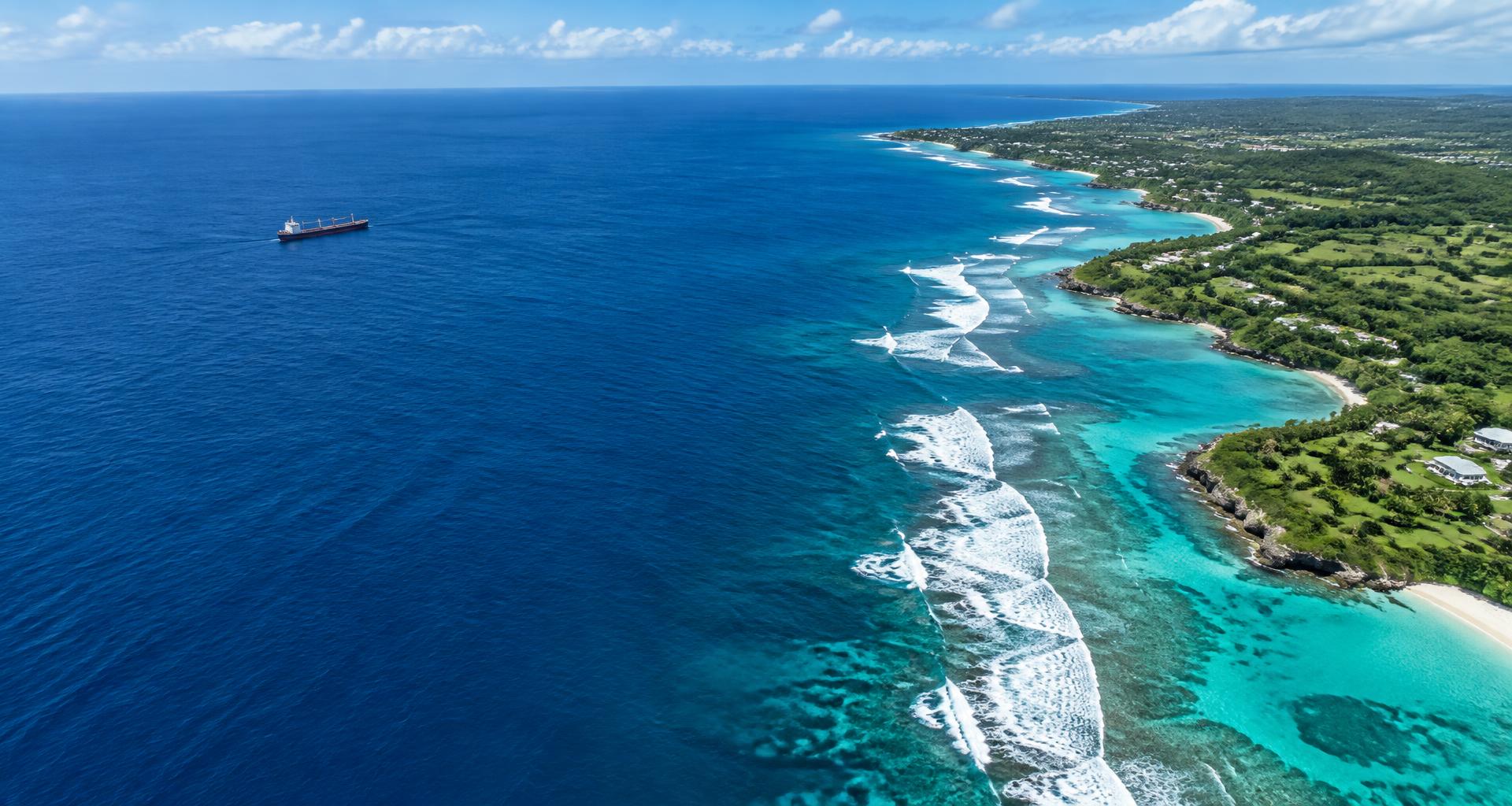
When I fly a drone over a coastline, I see what the beach hides. I see the shipping lanes, the cables, and the places where many paths meet. This report starts from that high view, then zooms in.
Shipping lanes
Global oil strategy moves tankers through the Caribbean Sea. More ships mean more chances for accidents and more attention from powerful nations.
Undersea cables
Our internet runs along the ocean floor. A dragging anchor, a fishing net, or a deliberate act can cut a cable—and an island’s connection to essential services.
Space infrastructure
Satellites offer backup internet and communications. That is good. It also raises a question every nation must answer: who controls the backup?
Put those views together. Our island nations need a way to stay connected when the seabed is cut. They need that connection without giving up control of their own security.
What sovereignty really means
Sovereignty is not isolation. No island can build every cable, satellite, and data center alone. Sovereignty means three things:
- We decide how our security data is handled.
- We have people who can run, check, and challenge the technology we use.
- We own some of the capacity, so no single outside company can switch us off.
The people came first, then the ownership.
The chip industry shows the pattern. The leaders did not start with factories. They started with people. They trained engineers through universities and apprenticeships, then built the factories.
Who sets the rules? The Frontier AI Accord
The source report states that executives from six frontier AI companies signed the White House Accord on Super Intelligence: Google, Anthropic, Meta, OpenAI, xAI, and Nvidia. Most of them lead the field, so the list shows who Washington considers building at the frontier. The signing date is marked for confirmation in the source.
The accord asks each company to do four things:
Monitor models
Monitor models during training and deployment, including for cybersecurity, biosecurity, and chemical threats.
Internal controls team
Keep an internal team to make sure those controls work.
Independent auditor
Hire an independent outside auditor to check them.
Board oversight
Give a board committee oversight of the reports.
It is voluntary. It has no penalties and no regulator. Its authors say these steps may later become law, but the accord does not require it.
Who sets the rules for the tools we depend on,
and what happens if they change them?
Why this matters for us: a voluntary accord is a statement of intent. It works only if the companies keep their word. That is the sovereignty question again, one layer up from satellites and data.
Our recommendation
Build the talent now. Own some of the capacity next.
Talent first
Create regional cohorts of engineers, technicians, data protection officers, and policy staff. Begin with the Caribbean Compute Pilot’s talent-first model; the first cohort can focus on women.
Shared access
Pool compute and connectivity so small nations do not each buy the same expensive equipment alone. Negotiate group satellite terms that protect data, local jobs, and crisis service.
Owned capacity
Allied nations pool resources to own infrastructure together: a regional ground station, a secure data center, or a small satellite program with partner launch access.
Who we pursue and why
These are targets, not commitments. Each has a clear reason to care and a specific ask. Status is as of the supplied report, October 12, 2026.
| Prospective partner | Why pursue | The ask | Status |
|---|---|---|---|
| RSS Secretariat Rear Admiral Errington Shurland | Regional security mandate for eight member-state police forces. | Sponsor the talent pilot and host the ownership conversation. | Not yet contacted |
| CARICOM IMPACS Lt. Col. Michael Jones | Regional security coordination; a natural home for shared capacity. | Review the world lab concept and name a regional owner. | Not yet contacted |
| UWI Symposium co-host | Develops the engineers and policy staff the talent track needs. | Co-design the first cohort curriculum. | Not yet contacted |
| Association of Caribbean Commissioners of Police Marcia Manning | Connects police leaders and training use cases across islands. | Pilot cable-outage and hurricane scenarios. | Not yet contacted |
| Allied governments & institutions To be named | Shared facilities, launch access, and funding. | Identify three partners willing to co-own a small capacity site. | Not yet identified |
| Compute & satellite providers AMD, Nvidia, satellite operators | Hardware for training and backup connectivity. | Explore regional programs and group terms—as conversations, not deals. | Not yet contacted |
Who is building their own space internet
The plain idea: countries build their own satellite internet so they do not have to depend on someone else’s.
The lesson from Ukraine
The supplied report describes Starlink as a lifeline for Ukraine’s wartime communications. It cites KRDO for a February 2026 statement that Russian-used terminals were cut off, and Anadolu Agency for a subsequent acknowledgment of a roughly two-week disruption. These are source-reported, dated claims, not independently checked here.
| Country or bloc | Program | Source-reported status · October 2026 | Source cited |
|---|---|---|---|
| United States | Starlink (SpaceX) | Operating commercial satellite internet; its operator can switch terminals on or off. | Wikipedia |
| Russia | Rassvet | The source reports 16 satellites launched in May 2026; one report targets 292 by 2027. | Euromaidan Press; Euronews |
| China | Guowang & Qianfan (G60) | Two low-orbit networks. The source reports Qianfan batches of 18 in April and July 2026. | CISLUNAR |
| European Union | IRIS² | Secure multi-orbit network, operated by SpaceRISE; the source reports accelerated deployment in August 2026. | EUSPA |
Dual use
The same satellite that gives an airline passenger Wi-Fi can also support military communications. That is why investors watch this market, and why public safety planners should watch it too.
Who can switch off our communications,
and what happens if they do?
Energy as leverage
Whoever controls the fuel supply holds leverage. The report connects the Strait of Hormuz to Havana: it cites SAN for Cuban fuel shortages, blackouts, and protests, and WTOP for Mexico’s efforts to restart fuel shipments. Disruption in a narrow global oil channel can raise costs for small island states.
Did Venezuela’s fall change the cost of disrupting Hormuz?
This remains a question to test, not a conclusion. The answer depends on evidence about Venezuelan crude reaching world markets, how quickly output could rise, and how much Gulf supply could be replaced. Until that evidence is in hand, this report treats the question as open.
A regional world lab, built for security only
Some of the newest AI tools learn from simulated worlds. These are called world models. They generate three-dimensional environments where machines and people can practice. A regional world lab would build those environments for security training and planning, owned by the region.
Cable outage
Simulate the outage, test backup routes, and train technicians and officials to respond.
Hurricane response
Model flooded roads, damaged ports, and shelter logistics before the storm arrives.
Port security
Train port staff, customs officers, and police in realistic scenes.
Guardrails
These rules belong in the foundation, not added later.
- Security use only. Training, planning, and response—not general-purpose deployment.
- No citizen surveillance. The lab does not track or profile people.
- Data stays in the region. Sensitive information is stored under regional law.
- Human oversight. A trained person reviews every high-stakes output.
- Allied buyers only. Access goes to partner governments that share these rules.
Ownership
A regional body, such as RSS or CARICOM IMPACS, or a nonprofit it designates, should hold the model and its income. Revenue from paid access should be reinvested in training and infrastructure, not sent out of the region.
The zoomed-in punch list
When the view from above is clear, zoom in on the next steps.
Next 30 days
Review with Ambassador Queeley. Confirm the regional sponsor for the talent pilot. Identify three potential partner governments or institutions.
Next 90 days
Draft the first cohort curriculum. Write a one-page satellite group-access term sheet. Build one undersea cable outage scenario.
Next 12 months
Stand up a shared compute and training site with an allied partner. Publish regional guardrails. Decide the ownership structure.
The ask
I ask the symposium for three things.
Attention
Keep undersea cables and satellite backup on the regional security agenda.
Partnership
Name the partners who will help build shared talent and capacity.
Ownership
Agree that any regional capability belongs to the region.
Security is not only about what we defend against. It is about what we build together. Let us build it on our terms.Open the presentation
Sources & appendix
This digital report adapts Felicia Ellis’s supplied document dated October 12, 2026. Public Safety AI is the presenting partner. External reporting and market facts below retain the source document’s stated status; they have not been independently verified for this edition.
Market facts recorded in the source
| Item | Source status | Detail | Source cited |
|---|---|---|---|
| AMD crosses $1 trillion | Confirmed, intraday in source | First crossed September 21, 2026; one source closed just below. | ROIC |
| AMD stock gain in 2026 | Partly confirmed in source | About 175% by one source (about 2.75 times the start). | Pulse2 |
| AMD buys World Labs | Confirmed in source | About $8.2B all-stock; announced September 28, 2026; closing expected by end of 2026. | SDxCentral |
| Meta and Scale AI | Confirmed in source | $14.3B for a 49% stake; $29B valuation; June 12, 2025. Voting terms not verified. | Maginative |
| Cursor round dropped | Reported in source | About $2B round reportedly dropped, April 2026; original Bloomberg report not opened. | Texxr |
| SpaceX buys Cursor | Confirmed in source | About $60B all-stock; announced June 16, 2026; closing reported August 14, 2026. | Gigazine |
| Meta’s Muse app | Dated confirmation in source | Launched September 8, 2026; No. 1 in U.S. App Store September 18–28. Current ranking not verified. | TechCrunch |